Finally, time for assembly
Introduction
After around 1,5 years of hectic, but still meticulous, focus on parts restoration, I came to a point where it was time to start with the final assembly in parallel. It was now late spring 2018. Since I have my own consulting company and would soon finalize an assignment, I could make the decision to take a break from work, to focus on getting the car done – “I’ll keep an eye out for new assignments but won’t search for them actively”.
I understood that it was going to be a lot of hard work. But never in my wildest fantasy could I foresee that I would work more than full time (my wife even went to Italy for studies, giving me full freedom for two months), very often together with one of my Ponton advisors, Mr Lundin, from June and still not being able to finish it during that year.

Mercedes-Benz type 219 being assembled in a rather primitive, but fully functional environment
Since my garage is too small for these activities, I had bought a sturdy, large tent to work in. The Swedish climate forced me to stop working in November. I also needed to start looking for a new assignment, i.e. secure the inflow of new, fresh money. I started a new project in March 2019, thereby remedying the effects of the continuous outflow of money. Hard evening and weekend work commenced, and I had her on the road in mid-June 2019. After that came adjustments and the discovery of a couple of things I needed to redo.
Experiences to learn from
The long time to complete the car was not only due to a combination of a huge underestimation of the activities involved but also waiting time for parts I had forgotten to buy etc (and that during the holiday season). It also turned out that I had to spend a lot of time on getting clarifications for correct assembly procedures. Mostly the workshop manuals will guide you, but not always. And then you start to ask around and realize you get as many different answers as people you ask. That doesn’t help… I didn’t want to rush things and do them wrong just because I was so close to the final. So, a lot of things that look simple from the beginning, with an estimated work effort of one day easily turns into three days hard work.
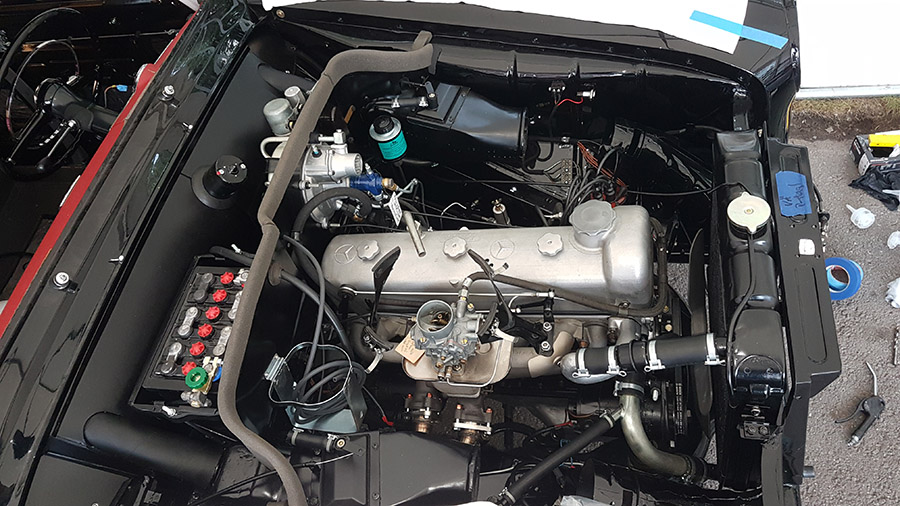
The 219 engine bay during assembly and detailing
As I have mentioned elsewhere on the website, you have to take into account that during a full restoration you disassemble 1000's of parts that have been married together for decades and maybe traveled hundreds of thousands of kilometers together. And then, during assembly, you replace some of them with new, unworn parts. Also, maybe even not the correct parts. You may have ordered the wrong part, or the wrong part has been delivered, and for some reason you don't realize it. Perhaps the new part has poor tolerances, poorer quality, or other negative characteristics. This will give you a host of unpleasant surprises. Do not assume that you are getting the right parts, including from Mercedes-Benz, even if you provided the correct part number, attached photos, drawings and sketches. Double check everything. Do not discard old parts until the new ones - and adjacent or interacting parts - are properly seated and functioning properly.
And then we have that thing about originality
I have an early -57 219 with many parts for -56 219/220a. Since I know the car (my father bought it new) I know that these parts are original and hence, if I need to replace them, I go for the same, "too old" parts. In many cases, not all though, this is also evident by reading the MB Spare parts list where "wrong" or "too old" parts are indicated for my chassis number and the -57 parts are correct first for later -57 chassis numbers.
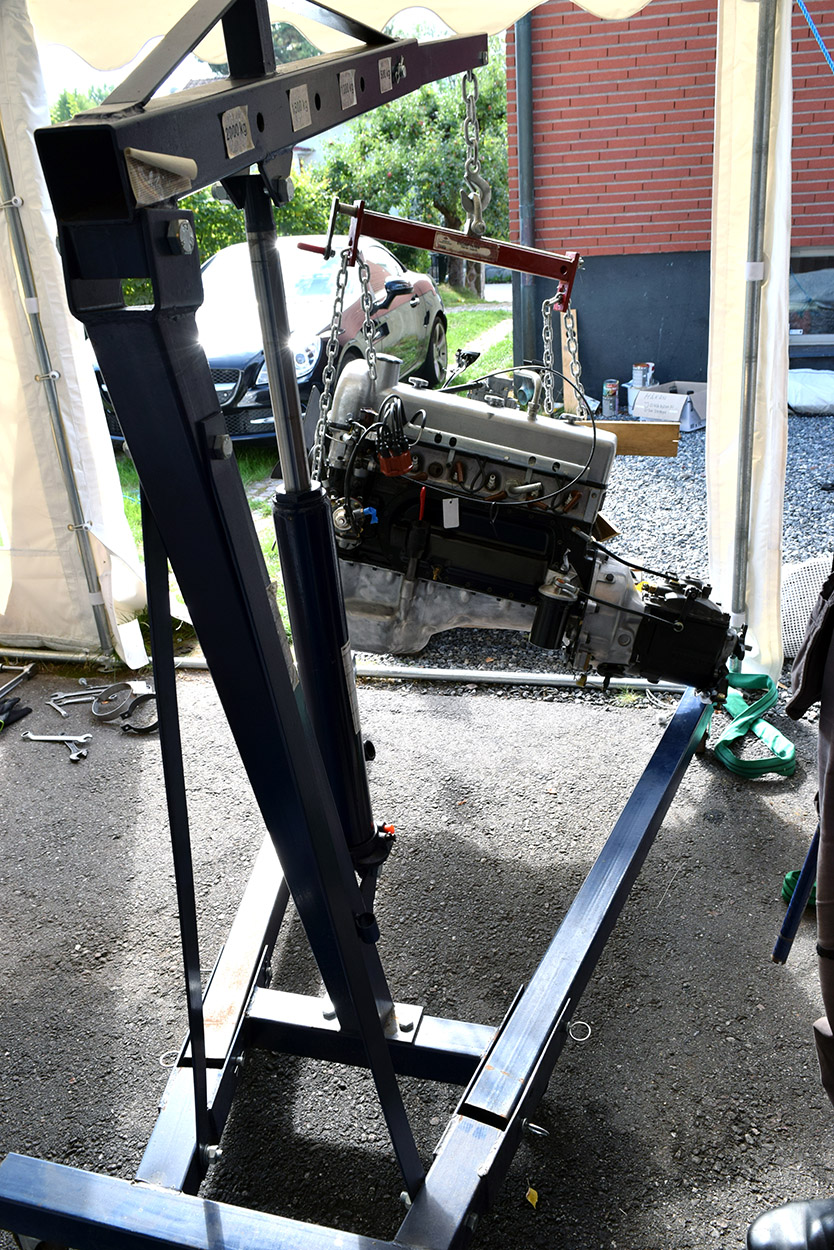
The M180II being prepared for going into the engine bay
I've done my restoration based on a lot of research, especially when I've found strange items in the car (and those are many and in some cases major), and that has revealed that the Pontons have gone through many, many small changes during the years of production so it is actually very difficult to say what is "original".
Our Pontons have a very strong personality, especially if they are close to a new model year.
How you solve your matter is however up to you; how strict you want to follow your car’s originality, availability of parts and its cost vs your wallets thickness. A Ponton can be very expensive.......
Structure of the Assembly section
In this section of the site, I only describe the assembly and maybe the following adjustments. The restoration of parts that were going on in parallel, as well as things I had to redo due to different reasons, are described in the Restoration section.
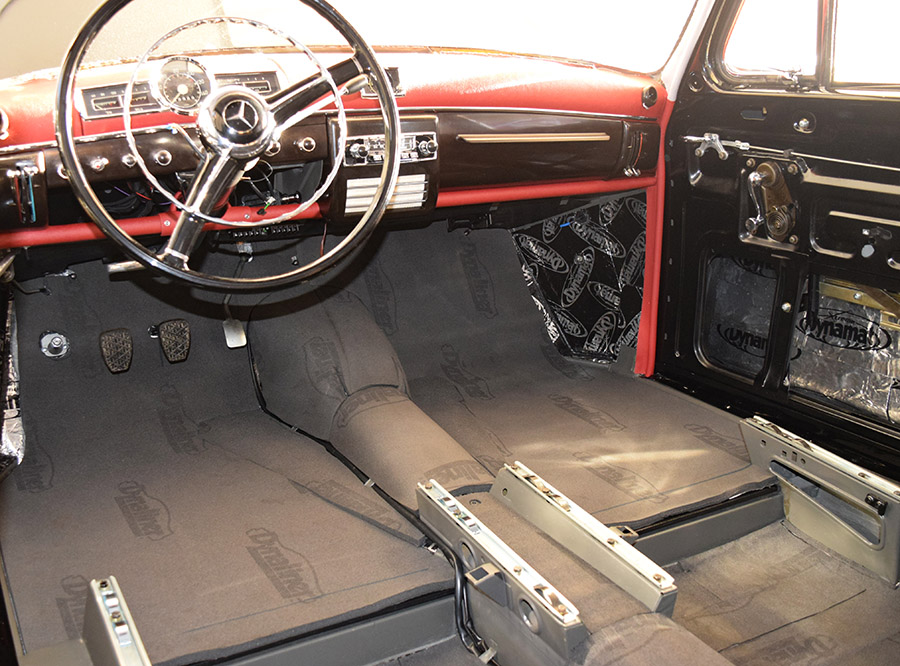
A couple of layers of Dynamat sound dampening on the floor and walls of the coupé
All steps for a complete assembly of the car are of course not described. For that amount of information and level of detail I refer to the workshop manuals and the other material presented in the article Restoration. The steps I followed, and their order, are listed and commented on a high level in the article Order of assembly.
In the sub-articles I have described certain steps/parts that gave me headaches, are not well described in the workshop manuals or which may be of interest due to other reasons. The sub-articles are divided into the Mercedes-Benz spare parts groups, i.e. not following my assembly steps per se.
If you need any clarifications, high quality versions of the pictures I’ve published on the site or additional pictures; contact me and I will try to help you.


